Entanglement Generation
EGP Protocol
This tutorial introduces a more realistic protocol implementation for
handling user requests using
RequestManager
to load experiment definitions and access other plugin modules. This
protocol may be useful as a template for implementing a real link
entanglement generation protocol using the Controller’s functionalities
across various plugin modules.
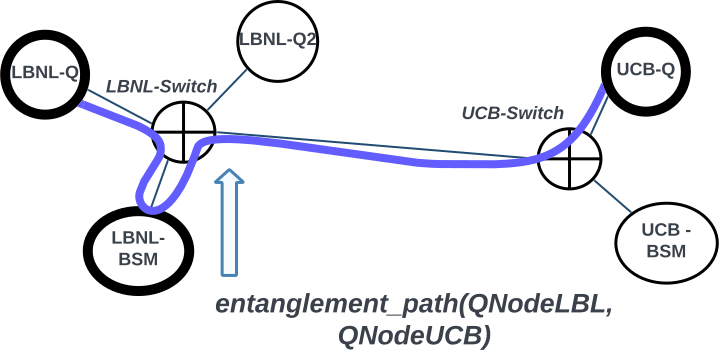
Figure 1 – Network topology used in the EGP tutorial.
Our EGP protocol requirements are as follows:
Allow an external client to contact the Controller using an
egpRequestmessage.An experiment definition contains experiment sequences for each agent.
The request message will include the following information:
A list of destinations (Agent IDs).
Minimum fidelity required for the entanglement pair.
The client will asynchronously receive a
responseStatusmessage with the results for the EGP request:Return code.
Return message.
The Controller will find a path between the two nodes, fetch timeslot availability across the involved nodes, translate the
egpRequestinto agent sequences for each agent, find common timeslots among the agents, and populate sequences for each agent for the experiment.
With the requirements stated, you will exercise the following control plane integrations to implement this functionality:
Define a protocol schema for the Message Bus.
Create a ProtocolPlugin for the Controller that handles external client requests, finds a path between the Agents, and schedules the experiment with RequestManager.
Create a test client to make
egpRequestcalls and display results.
The complete EGP tutorial source code may be found here.
Experiment Definition
An Experiment Definition maps an Experiment name to sequences of
experiments across involved agents. It consists of three types of classes:
Sequence, AgentSequences, and Experiment.
A Sequence defines the actual sequence the agent executes at the allocated time.
AgentSequences is a collection of Sequence instances for an agent to execute within the
Experiment.
class QnodeEGP(Sequence):
    name = "QnodeEGP.py"
    duration = timedelta(microseconds=1000)
    dependency = []


class BSMnodeEGP(Sequence):
    name = "BSMnodeEGP.py"
    duration = timedelta(microseconds=2000)
    dependency = []


class RepeaterEGP(Sequence):
    name = "RepeaterEGP.py"
    duration = timedelta(microseconds=3000)
    dependency = []


class QnodeBlackQuantun(Sequence):
    name = "QnodeBlackQuantum.py"
    duration = timedelta(microseconds=4000)
    dependency = []


class BSMnodeBlackQuantum(Sequence):
    name = "BSMnodeBlackQuantum.py"
    duration = timedelta(microseconds=5000)
    dependency = []


class EGPQnodeSequence(AgentSequences):
    name = "Entanglement Generation Sequence for Qnode"
    node_type = "QNode"
    sequences = [QnodeEGP]


class EGPBSMnodeSequence(AgentSequences):
    name = "Entanglement Generation Sequence for BSMnode"
    node_type = "BSMNode"
    sequences = [BSMnodeEGP]


class RepeaterEGP(AgentSequences):
    name = "Entanglement Generation Sequence for Repeater"
    node_type = "RepeaterNode"
    sequences = [RepeaterEGP]


class EntanglementGeneration(Experiment):
    name = "Entanglement Generation"
    agent_sequences = [EGPQnodeSequence, EGPQnodeSequence, EGPBSMnodeSequence]

    def get_sequence(self, agent_index):
        return self.agent_sequences[agent_index]
The get_sequence method in Experiment returns a list of AgentSequence classes in
an order that matches the hops found from find_path() in the routing module.
Protocol Schema
Two types of messages are required for our EGP protocol:
The request and response from the client to the Controller.
ScheduleManager asks each agent for its schedule (Built-in).
RequestManager sends allocation messages (Built-in).
Below is the egpRequest definition. This protocol message is
intended for use as an RPC in the control plane, so it contains the
required fields cmd, agentId, and payload. The payload
contains the request-specific fields, including source (a string),
destination (a string), and fidelity (a float). source and
destination must match the agent IDs registered in the Controller
for the routing module to find a path between them; otherwise, it will
fail.
EGPRequest:
  title: egpRequest
  type: object
  required:
    - cmd
    - agentId
    - payload
  properties:
    cmd:
      type: string
    agentId:
      type: string
    payload:
      type: object
      required:
        - source
        - destination
        - fidelity
      properties:
        source:
          type: string
        destination:
          type: string
        fidelity:
          type: number
Two other protocols are already built-in and are not required for a user plugin. They may be found in the quantnet_mq YAML files located within the scheduler.yaml and experiment.yaml under the schema/rpc sub-directory.
Controller Protocol Plugin
With the experiment and schema definitions in place, we can now implement the EGP protocol in the Controller. The EGP protocol is defined as a subclass of the ProtocolPlugin class, enabling the registration of handlers for commands outlined in the EGP schema.
The code for the EGP plugin is located in egp/__init__.py. It defines a ProtocolPlugin instance, responsible for processing the egpRequest command. Below is the full implementation:
import logging
from quantnet_controller.common.plugin import ProtocolPlugin, PluginType
from quantnet_controller.common.request import RequestManager, RequestType
from quantnet_mq import Code
from quantnet_mq.schema.models import egp, Status as responseStatus, QNode

logger = logging.getLogger(__name__)


class EGP(ProtocolPlugin):
    def __init__(self, context):
        super().__init__("egp", PluginType.PROTOCOL, context)
        self._client_commands = []
        self._server_commands = [
            ("egpRequest", self.handle_egp_request, "quantnet_mq.schema.models.egp.egpRequest"),
            ("egpQuery", self.handle_egp_query, "quantnet_mq.schema.models.egp.egpQuery"),
        ]
        self._msg_commands = list()
        self.ctx = context

        # Initialize RequestManager with EGP schema
        self.request_manager = RequestManager(
            context, plugin_schema=egp.egpRequest, request_type=RequestType.EXPERIMENT
        )

    def initialize(self):
        pass

    def destroy(self):
        pass

    def reset(self):
        pass

    def validate_request(self, req):
        """Validate that source and destination are QNodes."""
        nodes = self.ctx.rm.get_nodes(req.payload.source, req.payload.destination)
        for n in nodes:
            if n.systemSettings.type != QNode.__title__:
                raise Exception(f"Node {n.systemSettings.ID} is not a QNode")
        return nodes

    async def handle_egp_request(self, request):
        """Handle incoming EGP request."""
        # Create plugin-specific payload object
        egpreq = egp.egpRequest(**request)
        logger.info(f"Received EGP request: {egpreq.serialize()}")

        # Validate request
        try:
            self.validate_request(egpreq)
        except Exception as e:
            logger.error(f"Invalid argument in request: {e}")
            return egp.egpResponse(
                status=responseStatus(
                    code=Code.INVALID_ARGUMENT.value, value=Code.INVALID_ARGUMENT.name, message=f"{e}"
                )
            )

        # Find path between source and destination
        try:
            p = await self.ctx.router.find_path(egpreq.payload.source, egpreq.payload.destination)
            path = [str(x.systemSettings.ID) for x in p.hops]
            logger.info(f"Found valid resources: {path}")
        except Exception as e:
            logger.error(f"Could not find valid resources: {e}")
            return egp.egpResponse(
                status=responseStatus(
                    code=Code.INVALID_ARGUMENT.value, value=Code.INVALID_ARGUMENT.name, message=f"{e}"
                )
            )

        # Create experiment execution parameters
        parameters = {
            "exp_name": "Entanglement Generation",
            "path": p,
            # Additional experiment execution parameters can be added here
        }

        # Create Request object through RequestManager
        # Payload encapsulates the plugin request (source, destination, pairs, bellState, fidelity)
        request = self.request_manager.new_request(payload=egpreq, parameters=parameters)

        # Schedule the request for execution
        fut = self.request_manager.noSchedule(request, blocking=True)
        rc = await fut

        return egp.egpResponse(
            status=responseStatus(code=rc.value, value=rc.name, message=f"Path: {path}"),
            rtype=str(egpreq.cmd),
            rid=request.id,
        )

    async def handle_egp_query(self, request):
        """Handle EGP query for request status/results."""
        payload = egp.egpQuery(**request)
        logger.info(f"Received EGP query: {payload.serialize()}")

        try:
            rid = str(payload.payload.rid)

            # Get request with experiment result
            req = await self.request_manager.get_request(rid, include_result=True)

            if req is None:
                raise Exception("Request ID not found")

            return egp.egpResponse(
                status=responseStatus(
                    code=req.status_code.value, value=req.status_code.name, message=req.status_message
                ),
                rid=rid,
                data=getattr(req, "experiment_data", None),
            )

        except Exception as e:
            logger.error(f"Failed to get experiment status: {e}")
            return egp.egpResponse(
                status=responseStatus(
                    code=Code.INVALID_ARGUMENT.value, value=Code.INVALID_ARGUMENT.name, message=f"{e}"
                ),
                rid=rid if "rid" in locals() else None,
            )
Initialization: The EGP plugin is initialized with RequestManager. RequestManager tries to load experiment definition file “experiment.py” within the plugin’s location.
Request Validation: The validate_request() method ensures all nodes in the request are valid quantum nodes (QNode).
Handling Requests: The handle_egp_request() method: - Validates the request. - Finds a path using the router plugin. - Creates parameters for the experiment, including exp_name, which must match the experiment definition name. - Schedules the experiment using the RequestManager.
The RequestManager translates the experiment definition into agent-specific instructions and submits these to the agents. It leverages the schedule() method of the scheduler plugin to handle timing and coordination.
Client program
To test the EGP protocol, we can use the following client program:
import os
import json
import asyncio
from quantnet_mq.rpcclient import RPCClient
from quantnet_mq.schema.models import Schema


async def egp_cb(res):
    try:
        ret = json.loads(res)
        print (ret)
    except Exception as e:
        print (e)

async def do_egp(client, src, dst, fidelity):
    msg = {"source": src, "destination": dst, "fidelity": fidelity}
    req = await client.call("egpRequest", msg, timeout=20.0, sync=False)
    await req

async def main():
    Schema.load_schema("../schema/egp.yaml", ns="egp")
    client = RPCClient("egp-client", host=os.getenv("HOST", "localhost"))
    client.set_handler("egpRequest", egp_cb, "quantnet_mq.schema.models.egp.egpRequest")
    await client.start()
    await do_egp(client, "LBNL-Q", "UCB-Q", 0.88)


if __name__ == "__main__":
    asyncio.run(main())
Schema Loading: The EGP schema is loaded to generate request/response models.
RPC Client: An RPC client (RPCClient) is created to send the egpRequest command and handle responses asynchronously.
Execution Example
Running the client with LBNL-Q as the source and UCB-Q as the destination, with a fidelity of 0.88, returns the following:
$ python3 test_egp.py
{'status': {'code': 0, 'value': 'OK', 'message': "['UCB-Q', 'UCB-SWITCH', 'LBNL-SWITCH', 'LBNL-BSM', 'LBNL-SWITCH', 'LBNL-Q']"}}
Controller logs for this request:
2025-10-30 21:25:45,429 egp                           7703     INFO Received EGP request: {"cmd": "egpRequest", "agentId": "egp-client", "payload": {"source": "LBNL-Q", "destination": "UCB-Q", "pairs": 1, "bellState": "11", "fidelity": 0.88}}
2025-10-30 21:25:45,568 egp                           7703     INFO Found valid resources: ['LBNL-Q', 'LBNL-SWITCH', 'LBNL-BSM', 'LBNL-SWITCH', 'UCB-SWITCH', 'UCB-Q']
2025-10-30 21:25:45,622 quantnet_controller.common.request 7703     INFO Created new request f358e30aa24a4ec38a84d314fe3f0f1d of type RequestType.EXPERIMENT
2025-10-30 21:25:45,839 quantnet_controller.common.request_translator 7703     INFO Loading experiment Entanglement Generation
2025-10-30 21:25:45,840 quantnet_controller.common.request_translator 7703     INFO Visualizing Experiment detail

----------------------------------------
Entanglement Generation translates to:

Entanglement Generation sequence for Qnode for an agent with sequences:
experiments/dds_output.py - duration: 1000.0 ms

Entanglement Generation sequence for Qnode for an agent with sequences:
experiments/dds_output.py - duration: 1000.0 ms

Entanglement Generation sequence for BSMnode for an agent with sequences:
experiments/dds_output.py - duration: 2000.0 ms
----------------------------------------

2025-10-30 21:25:45,841 quantnet_controller.common.request_translator 7703     INFO Found agents [<Literal<str> LBNL-Q>, <Literal<str> UCB-Q>, <Literal<str> LBNL-BSM>]
2025-10-30 21:25:45,900 quantnet_controller.common.request_translator 7703     INFO Agent LBNL-Q is ready.
2025-10-30 21:25:45,960 quantnet_controller.common.request_translator 7703     INFO Agent UCB-Q is ready.
2025-10-30 21:25:46,016 quantnet_controller.common.request_translator 7703     INFO Agent LBNL-BSM is ready.
2025-10-30 21:25:46,017 quantnet_controller.common.request_translator 7703     INFO translating request: f358e30aa24a4ec38a84d314fe3f0f1d
2025-10-30 21:25:46,017 quantnet_controller.common.request_translator 7703     INFO Handling timeslots for agents
2025-10-30 21:25:46,017 schedule_manager              7703     INFO Fetching timeslots from agents [<Literal<str> LBNL-Q>, <Literal<str> UCB-Q>, <Literal<str> LBNL-BSM>]
2025-10-30 21:25:46,017 schedule_manager              7703     INFO getting schedule from LBNL-Q
2025-10-30 21:25:46,020 schedule_manager              7703     INFO getting schedule from UCB-Q
2025-10-30 21:25:46,020 schedule_manager              7703     INFO getting schedule from LBNL-BSM
2025-10-30 21:25:46,041 quantnet_controller.common.request_translator 7703     INFO Finding common timeslots from agents [<Literal<str> LBNL-Q>, <Literal<str> UCB-Q>, <Literal<str> LBNL-BSM>]
2025-10-30 21:25:46,044 quantnet_controller.common.request_translator 7703     INFO timeslots: [0]
2025-10-30 21:25:46,044 quantnet_controller.common.request_translator 7703     INFO Submitting sequences experiments/dds_output.py to LBNL-Q with slot [0]
2025-10-30 21:25:46,044 quantnet_controller.common.request_translator 7703     INFO timeslots: [0]
2025-10-30 21:25:46,044 quantnet_controller.common.request_translator 7703     INFO Submitting sequences experiments/dds_output.py to UCB-Q with slot [0]
2025-10-30 21:25:46,044 quantnet_controller.common.request_translator 7703     INFO timeslots: [0]
2025-10-30 21:25:46,044 quantnet_controller.common.request_translator 7703     INFO Submitting sequences experiments/dds_output.py to LBNL-BSM with slot [0]
The scheduler identifies timeslots for agents and coordinates the experiment.
The schedule_manager translates the experiment into sequences and submits them to agents for execution.
This concludes the implementation and testing of the EGP protocol.