Scheduling Module
Two-level scheduler
Network level
The Controller has a global scheduler to handle network-wide (global) non-real-time functions such as quantum network topology discovery, quantum network monitoring, and quantum link calibration etc. The controller also handles user requests on an event-driven basis. When serving a user request, the controller performs alternating cycles between calibration and operational mode.
Node level
Each Agent implements a node with dedicated real-time control system. Each node has a local scheduler to handle node-wide (local) real-time functions that have tight time constraints, such as qubit control and quantum protocol implementation etc.
User request handling
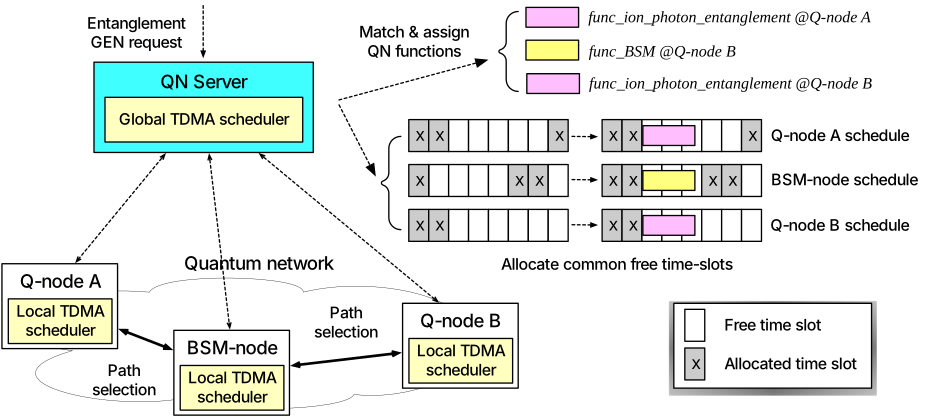
Figure 1. User request handling in two-level scheduler
When a user requests an QN request, controller orchestrate the request handling in following order.
The controller performs a request analysis. The request is admitted only if its requirement can be fulfilled.
If the request is admitted, the controller proceeds to call a routingroutine to select a path to establish entanglement.
The controller matches and assigns functions required for remote entanglement generation for each node along the path. We assume a singlefunction is required at each node, which are func_ion_photon_entanglement at Q-node A, func_BSM at BSM-node, and func_ion_photon_entanglement at Q-node B, respectively. The control framework has full knowledge of these functions, which are well-characterized and pre-configured.
The controller reaches out to Q-node A, BSM-node, and Q-node B for the time-slot allocation status of their local schedulers.
Q-node A, BSM-node, and Q-node B all reply with their local schedules.
The controller proceeds to call the network-wide scheduler to allocate common free time-slots for func_ion_photon_entanglement at Q-node A, func_BSM at BSM-node, and func_ion_photon_entanglement at Q-node B, such that these functions can be scheduled simultaneously at time T1. Afterwards, the controller updates Q-node A, BSM-node, and Q-node B with the newly assigned time-slots.
Q-node A, BSM-node, and Q-node B accept and confirm the newly assigned time-slots.
At time T1, the local schedulers run func_ion_photon_entanglement at Q-node A, func_BSM at BSM-node, and func_ion_photon_entanglement at Q-node B, respectively.
Calibration handling

Figure 2. Dependency handling using a DAG
When an Agent starts, its node-level scheduler manages local calibration tasks as defined in the agent’s configuration file. This ensures that real-time devices remain calibrated and ready for incoming tasks. To manage these calibration tasks, the agent reads the task section of its configuration file:
Example:
[tasks]
[[light_calibration]]
path=dummy_lsrc_calibration.py

[[light_calibration2]]
path=dummy_lsrc_calibration.py

[[cavity_calibration]]
path=dummy_cavity_calibration.py
With the task definitions, it performs the following steps:
Each constructs a Directed Acyclic Graph (DAG) with an empty root node, based on the local calibration definitions from the configuration file. This DAG is used to track task dependencies. Each non-root node represents a calibration task, while the edges between nodes represent dependencies. Tasks with no dependencies are connected directly to the root node via an edge.
The DAG is traversed using a Breadth-First Search (BFS) algorithm, and tasks are scheduled in the agent’s local schedule in the order they are encountered.
Initially, the state of all nodes is set to OUT_OF_SPEC. The DAG is periodically traversed using BFS to check the state of each node. If a calibration task is valid (i.e., it was performed correctly within the specified interval), the node’s state is updated to IN_SPEC. If a calibration task becomes invalid, the task and all its predecessors are set to OUT_OF_SPEC.
If the root node’s state changes between IN_SPEC and OUT_OF_SPEC, the agent sends a monitoring message to the controller to report the status change.